
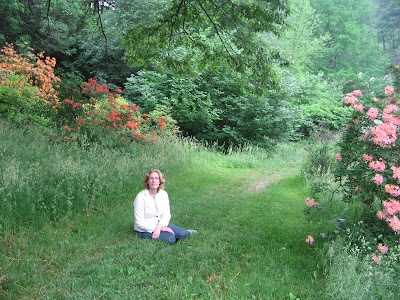
I'm trying to find time between audition prep (I'll have had seven this summer!), festival prep, recital planning, freelance grantwriting, and dayjob to structure and write my impressions of Boston. In just a few weeks I'll have my one year anniversary of life in this town. Meanwhile, I can share this story with you that happened just this morning.
One of my gripes (not like I have that many ;-) is that Boston fails to fill me with wonder. That is, I haven't encountered one single spot in the city where I've paused, admired, and thought "Oh the greatness of man!" Am I being too demanding? Well, I felt something like this on nearly every subway ride over the Manhattan bridge. A walk through the canyons of midtown or the tall peaks of Wall Street makes one feel like a god.
And in Rome, don't even get me started. Not just the Pantheon or the Colosseum but a crumpled napkin from a rip-off bar or a pile of dust from a construction site were enough to make my eyes go wide. The Puritan ethic of austerity and utility seem to have imbued architecture and city planning in Boston for all eternity. Sure, there are a few iconic churches and a couple of interesting modern buildings, but it's all on a small, restrained scale that does not overwhelm.
But what I am finding - slowly, glacierly - is a bit of what I always had experienced on my visits to Boston over the years: humanity. Friends gathering for dinner at home, new acquaintences becoming friends, people planning excursions to the many pretty villages close to town.
The workplace, however, seems to be exceedingly frosty. I've had two jobs here now, both times sharing an office with someone else, and both times only speaking to my office mate and/or boss only when absolutely necessary. There is no greeting or only a very reluctant hello when you walk in the door each morning. I used to say "bless you" when the other guy sneezed, but it got awkward when he would barely respond and didn't return the favor. Sitting down with colleagues in the lunch room makes me feel like a ghost: I appear to be invisible, no one addresses me, and I can't seem to make my way into the conversation. Whatever happened to the good old, "Hi, how are you, how was your weekend?" I swear, if my heart stopped right now no one would notice until the cleaning lady came!
So I suppose when a little human interaction happens in this ice block it seems like an exceptional event. Here, at last, is my story:
Mary W., a Christian first name and an African last, crooked glasses and relaxed hair, prim office wardrobe and an ample rear-end. She sits at her desk every day from nine to five, headphones permanently on her head.
“Do you sing?” Her question to me would sound like an accusation, but her voice has that delicious West African lilt. “How do you know?” I am surprised. Someone had found copies of my sheet music in the copier, and thought it was hers. She composes, she explains, but she can’t read or write music. She marvels that I can. She sings melodies in Swahili and records them to beat. “Do you have a recording of your work I can listen too?” She hands me a homemade CD from her computer, and I listen, and thank her, and we smile like two schoolgirls sharing a secret.
She replaces her headphones on her ears, and turns back to her work. High above her desk in bold print is Psalm 111:5: He provides food for those who fear him; he remembers his covenant forever.
Friday, July 28, 2006
Thursday, July 20, 2006
finding the words
I've been happily living part-time in the fantasy world of Haruki Murakami, whose beautiful and surreal writing defies description. Towards the end of Kafka on the Shore, his latest novel, a line leapt out at me:
"Memories warm you up from the inside. But they also tear you apart."
Tearing apart reminded me of imagery from Bach cantatas, and I thought it would sound even more dramatic in German:
"Erinnerungen wärmen Dich von innen auf. Doch sie reißen Dich auch auseinander."
Nowadays, I think with fondness of the warm memories I have of the hot country I was in this time last year, so Italian came to mind:
"Le memorie ti riscaldano dall'interno. Ma ti fanno anche a pezzi."
I wonder what would I would think of if I knew the original Japanese....
Thursday, July 13, 2006
New Look
Do we like it? Hate it? I got tired of the fuzzy typeface and went looking for higher resolution. Don't be surprised if this blog goes through a few face-lifts in the coming months. If I'm calling myself tech savvy, it's time to walk the walk.
I meant to write last night, but collapsed with exhaustion after a rather intense kickboxing class (stop laughing). Every so often it's a good idea to bring this journal back to my original intent: A Singer's Journal.
I practiced well last night, it's a great feeling. I got together on Tuesday to rehearse with a pianist friend (yes, we like making friends with keyboardists who actual want to work with me, not just collect cash to work for me!), but we ended up gabbing and planning instead of singing, so I had a night off. Maybe that's what made my throat more relaxed today, but somehow I was able to sing with greater ease and strength than usual. The trick that I have to keep reminding myself of is in the support system. I had thought of support as abdominal strength, but it actually has to do with using the stomach muscles to open the rib cage, creating more space for resonance. Newborns understand this extremely well, which is why they can produce such powerful sounds with limited muscle.
Good support also frees up the throat, which is the next important space for resonance. The more space, the better the sound, the easier the production, the less air you need, the better the carrying power. The paradox of studying any instrument is that you must work extremely hard for it to become easy. I'm owning the first part of that idea, and finally beginning to accept that in my practice, if it feels easy, it probably is right.
Well, that's enough for boring vacl technique now, isn't it? Back to dreary, soul-searching pity parties.
Monday, July 10, 2006
I've been writing
Really, I have. I’ve written quite a bit over these past two weeks, though none of it’s appeared here. I finished several essays about my impressions of Boston, and the latest challenges and opportunities that have come my way. I wrote a beautiful eulogy for the unexpected death of Lorraine Hunt Lieberson, the woman who was not only my favorite singer but my role model, whose voice I hear when I envision the sound I am striving for. I wrote a charming parody of the sort of poetic free verse one finds in 17th century French secular cantatas. I wrote character studies – for the first time I’ve had ideas for characters! – and sketched outlines for soul-searing stories that lay bear the human condition.
It’s a pity that these texts have only appeared on the interior of my eyelids, and never on paper. Working as much as I do now – and not enough on music projects, unfortunately – I find plenty of fodder for inspiration, but less time and energy to write it down. My non-dayjob hours have to be devoted to an evening practice, and whatever I can do to work on the pile of repertoire I wish to learn this summer. Time to develop myself as a writer – and singer – will have to be found some other season, maybe next year.
Yet, being busy also keeps my mind energized, and has somehow given me the drive to have ideas for new things to write about and music to pursue. If I was back on my care-free part-time schedule, I might clock more hours in the library, but I would also find more ways to fritter away time, and new things to frustrate me. Leisure and contentment does not usually yield great art: when Brahms was pining away for Clara Schumann he wrote his masterpieces, when he was happy he wrote plonk, like the Hungarian dances.
It takes discipline to create a beautiful voice – written or sung. I would never characterize myself as a disciplined person. As a child I would be more likely to curl up with a book and then stare into space, rather than immerse myself in the story. I don’t have the ambition of some of my peers, never being able to tolerate long hours in the office or ruthless behavior with colleagues. This summer is a test of my dreams: can I make some progress on them while making some money?
I’m in the office right now, and should logoff to face my Monday morning and the (not altogether uninteresting work) at hand. My music sits in my apartment, damp with humidity. My voice sits silently in my throat, as if it didn’t exist at all. Those characters I dreamt up go about their days as usual, occasionally blinking at me with expectation.
Here's an idea for a new character: a relatively young women with some talent and drive, who quits bellyaching about not being able to do the things she wants to and actually knuckles down and gets the work done.
Thursday, June 22, 2006
Amanda's First Poem
I am running
Late across
Roads that hurt
My soles.
Sweat covers me
In layers and
I am nervous and
My heart races.
Cars and noise
Move faster than me.
I fail to cross on green when
I catch my eye on
A rising shape:
Your arm, above your shoulder,
Forming a square beside your head.
White skin and clear eyes,
Shining for me at sunset.
Monday, June 05, 2006
Update
After that somewhat dreary last post, I spoke with three overseas friends, including a woman I hadn't seen or been in touch with since 2002. Is there anything as nice as hearing a smile in the voice of someone you care about, and who is happy to speak to you too? If there will ever be a time when I cannot hear music, let me at least be able to hear the voices of my friends.
Tuesday, May 30, 2006
In Touch
Hello there, poor neglected little blog. And hello to you, poor neglected little reader. Has it really been over a month since I last sat down to write? Tut tut. I’ve been caught up in a web of work to do, as well as my customary brooding. Let me explain.
First, I was busy with recital prep, then the event itself, and the inevitable post-recital funk. Then planning for my whirlwind social tour of New York, which involved visiting with no fewer than nine friends (ten including the baby) plus family, and having long, excited conversations on such topics as life plans, relationships, careers, heartbreak, etc. I’m zonked. I won’t regale you with summaries of all those girlfriend bonding sessions, why don’t I just talk about me for a change. :-)
Grief counselors have identified Five Stages of Recital Preparation:
1. Denial: “The recital’s in two weeks?”
2. Anger: “I hate this music, I hate my harpsichordist, I hate you….”
3. Bargaining: “Why do I have to do this? Can’t someone else sing the thing instead?”
4. Depression: “I can’t do this. I’m the worst singer in the world. And I think I’m getting fat.”
5. Acceptance: “I am going to sing this and it’s going to be fabulous and lots of fun. Dammit.”
But go through with it I did, and I even lived to talk about it. It was probably the first performance I gave where I didn’t get tired of hearing my own voice towards the end of the program, or worry if people were bored. I earned high praise from a prof whose heart I’ve been trying to win (professionally speaking, absolutely), and my biggest fan, which would be my Dad, was ever-proud. Then again, he would be proud if all I did was step on the stage and sneeze.
I was a duck out of water for the first week or so after the concert, not knowing what to do with myself or what music to work on. I had lived with some of this rep for close to a year, and as much as I was eager to bring it to performance, I knew I would be reluctant to leave those songs behind, as if they were old friends. But, the 90-minute concert came and went, there is no more work to be done on it, and the music is shelved and put away. But I still sing the tunes to myself, with the lusty nostalgia of recalling an old affair. Now it’s on to new music, new opportunities, and the next steps.
Back in New York, I was touching base with people I consider close friends. Now that I’m out of town, seeing them for a few hours feels like precious moments, as we try to squeeze in a life update since my last visit. Granted, now that I have to make an effort to see these folks I get in some good quality time, and in fact, I might see them more frequently now than when I was living in town. But still, I wonder how long and how deep these long-distance friendships can run.
Friendships, unlike pieces of music, require constant upkeep, attention, care, and feeding. I try to stay close to my long distance friends, but on any given day, there is a finite number of “Hi, how are you” emails I can write. And I think that even in person I can estrange myself from my companions, perhaps with the self-obsession that singers cultivate. Already in my short time in Boston there have been some goodbyes.
Whatever happened to those Dutch girls who visited me a while ago? Or the German relatives I met only once? Or my politics professor who I adored. Or my college friends who have moved far away. Or my tenuous friendships with old coworkers. And what about that certain young man, who perhaps right now is finishing his workday at the office where I used to greet him, turning towards home past castles and pine trees that seem to float above the skyline.
Maybe I’ll look them up the next time I’m in town. Maybe we’ll get together for beers and smiles and it will be as if we never were apart. Maybe we’ll beat the odds and reunite after years of no contact and eventually claim that we’ve known each other for most of our lives.
Or maybe we won’t. Maybe I’ll just make new friends. And eventually leave them too.
Tuesday, April 25, 2006
organically
Funny, I had been planning on writing down my hilarious impressions of my adopted hometown, but, in this time of pressures from work, school, and what I’ll generously call my music career, I’m afraid you’re in for another emotional post.
Some things have to happen on their own time. You can’t hurry up and grow your organic wasabi root – the thing can take up to three years to grow, organic or not. You can’t hurry up and make your voice do what you want it to do. You can’t wake up one day and have the career you want.
Welcome to the world of vocal studies. You know how you want to sound, and what it is you’d like to be able to do. Unfortunately, at any given point, your body is about three months behind your mind. Musicians get so frustrated in the practice room because of this. At the very least, writing is an art in which the finished product is not based on your performance in one instant. I can spend hours – or minutes – caressing a sentence, and the mistakes stay on the cutting room floor. I can also spend hours in the practice room, but mistakes will still end up in the performance. You can’t rush your own progress, you can only be impatient with it.
I’m making perfectly good progress. I feel that every time I perform is better than the last, I work hard to behave professionally, I take every performing experience seriously, and I’m an entrepreneur by creating performing opportunities. So isn’t it annoying that the other people’s success feels like my own failure? A colleague wins a steady performing job, without even auditioning. She was in the finals the year before, and they just decided to give it to her this year. In so many ways, I’m not at that point.
Just a matter of time, you say, these things have a way of working themselves out, stick around awhile and things will happen for you too. Hmm. It ain’t so easy in an unforgiving profession. Though I’m reminded of a musician I met a few years back. He played some obscure Renaissance instrument, like the crumhorn or the bombard. He was describing his career, and how it takes quite a while for things to get rolling along. But he did conclude that there’s always a space for the next batch of musicians. “Cause y’know why? People eventually die.”


Tuesday, April 11, 2006
A little too busy to properly post...
As evidence of the sleep-deprived, swamped state I’m in, I was laughing to tears during my continuo class this morning. Why? I cracked up whenever the prof described the plucking mechanism of the harpsichord. It brought to mind a favorite tongue twister:
http://www.users.globalnet.co.uk/~mentor01/song.htm
“She’s lost it,” proclaimed a friend.
http://www.users.globalnet.co.uk/~mentor01/song.htm
“She’s lost it,” proclaimed a friend.
Thursday, March 30, 2006
Strange Dreams
Just before going to sleep the other night I read an email from a friend of mine (una carissima amica mia che voglio bene, che mi manca tantissimo!), who wrote with some interesting news and friendly greetings. In my dreams that night, I dreamt she had also wrote that she enjoyed reading my blog, but just wished I wasn’t so egotistical and snooty. The first thing I did when I awoke was to re-read the email. It was as I remembered, of course not as I dreamt, but I swear I could have seen the words before me.
Last night, I remember only details from a long dream. I was on a train ride, in colors of dark green and blue, and on one of the seats I found three frozen items: a package of fruit, similar to what you would find at a deli, a baby, and something else I can’t remember. That’s right, a frozen baby. Its hair was blonde and brittle, but its skin was rosy and soft, like a normal baby’s, just very cold. I knew that it was still alive. I think the rest of the dream involved trying to locate the baby’s parents, and eventually my mom entered and told me she had found the father. He was in his 70’s and wanted to get rid of the child because he knew it would be brain damaged (whether or not that was a result of the freezing, my dream didn’t make clear.) Mom pointed out that the baby’s developmental delays were evident (it had begun to thaw out) and noted its deformed head as proof.
They say that you are everything you dream about. It makes perfect sense – no one else put these thoughts in my mind, they only came from me. What should I make of them?
Monday, March 27, 2006
Nota Bene
Heavens to Betsy! My last post seems to have struck some complicated chords in some of ye, so here is a handy set of guidelines to improve your enjoyment of Amanda’s blog:
- I write this online journal in lieu of an offline one. By reading, you are opening the Pandora’s box of my most intimate thoughts. I’m delighted that you read! But you have been warned, all of this stuff is close to the bone.
- Remember that I write sometimes late at night or in fragmented sections, which can yield some occasional incoherence, contradictory conclusions, or not very nice things about you personally.
- If the latter occurs, do feel free to leave extensive rebuttal remarks in the comments section! (The more web traffic I can claim, the more attractive I can make this blog to advertisers, the more revenue it will produce, etc. ;-)
- My original goal with starting a blog was to inspire myself to try to write fiction. Brace yourself my cherubs, that just might happen soon! As such, don’t believe everything you read…
- But that said, don’t take it all personally. When I address “you,” how do YOU know who I’m talking to??? It could be you, or likely someone else, or I’m just making someone up and messin’ with ya (see rule #4).
- As with all intensely good things, pace yourself. Think of my writing as a delicacy, like dark chocolate, black truffles, or celestial ambrosia. Just a few bites (or paragraphs) can be overwhelming to mere mortals ;-D.
- You know that I write, but I really don’t know who reads! As such, forgive me if I forget my audience and write something that rubs you the wrong way. I truly mean no offense.
- By all means, start your own blog, and see how it changes your point of view…
Monday, March 20, 2006
The One
Frankly, I don’t buy it. We spend our adult lives looking for our One True Love, but I don’t believe there’s only one person out there for each of us. Aren’t we approaching seven billion human beings on earth by now? There must be 10 or 12 guys out there I would get along with just fine.
But whether it’s because the media tells me to, or my mother, or the social messages society gives to girls, my romantic ambitions are more important to me right now than my musical ones. Yup, dish out that tired cliché of marriage and family and I will lap it all up.
It is likely just a matter of time before I settle down. I view it very dryly as a straightforward systems analysis: I am of proper marriageable age, I will look for others of proper marriageable age (much in the way I would search for a job, apartment, or sandals), I will locate one, and that will be that. Done. I know from friends’ experience with all types of dating, that it is absolutely never that simple. And often, my friends have given their hearts to men who have disappointed them over and over. I guess you could say I’ve been lucky of late; I haven’t had my heart broken in nearly 10 years. (“You’re due,” commented a friend recently.) Instead, I’m the one who entices men only to break their hearts. A perfectly nice man will grow fond of me and offer me his heart, which I then rip out of his chest and eat while it’s still beating, dripping blood all down my sleeve.
My parents named me Amanda, which comes from the Latin and means “one to be loved.” How could anyone be mean to me when my name so clearly instructs otherwise? Overall, the name has served me well. I’ve felt surrounded and buoyed by love, especially as I’ve gotten older. Because for the most part, everybody loves me.
Follow my imagination for just a paragraph. From store clerks to boyfriends, long-time classmates to week-long co-workers, perfect strangers to true friends, people fall in love with me. I walk into a room and conquer them with my face. What could it be? The blonde corona that completes my robin’s egg blue eyes? My golden tresses? My slender wrists or graceful walk? True, there is the occasional ignoramus who finds me to be a hyperactive bore, and I’m certainly aware that classier, more beautiful women abound, but otherwise, I’m enjoying being at a place in life where my self consciousness just might be matched by my self confidence.
Anyway. So, without launching into a sweltering stew of trite, what’s love actually supposed to be? Infatuation? Deep admiration? Partnership? Friendship in the extreme?
“Yes,” you answer unequivocally, when I ask you if you’ve been in love. “Three or four times.” But that last qualification naturally leads to the question: “Three or four times?” It raises the issue that has bewitched anyone who has ever been in a mental institution: What is love? I would define love as something that doesn’t end. And as willingness to sacrifice a bit of yourself for another person. And as being unable to take your eyes away from your beloved. “I love you” has crossed my lips countless times with various people, but by my own definition, I was misguided.
You, whose white shoulders I’ve never touched, might I love you? And you, who broke my heart so completely, that I surely must have been in love. And, my dear you. I am sorry, but it might not have been love at all, but it was certainly loyalty. And you, I don’t know what to make of you at all just yet.
Amanda, Amanda, one to be loved. Since I was a little girl I’ve wanted nothing more than to find someone who would love me forever. That turns out to be the easy part. Amanda, Amanda, how strange would it be if you could not love?
The one pure love I can claim, (apart from my family), is what I feel in the practice room and on the stage. To open my lungs and relax my throat, to turn my body into an instrument. To feel words form on my lips and sound vibrate across my chin, cheekbones, and brow. It is a love for the passions of the composers and poets who created the works I sing. The very love they describe in art is the love I hope to discover in life, but have felt only vicariously, like a person who knows the ocean only from paintings.
Let me share with you a prayer that I’ve been listening to lately. It’s not a prayer at all, actually, but a beautiful Mozart trio. Any of the vocal lines would be exquisite on their own, but combined, it is brief glimpse of perfection itself. Listen to it here, read it below, and even if you don’t speak Italian, say the words out loud, for just a bit of Italian on the lips will make you feel amazing.
Soave sia il vento
Tranquilla sia l’onda
Ed ogni elemento
Benigno risponda
Ai nostri desir.
May the winds be soft,
May the waves be tranquil,
And each element
Respond gently
To our desires.
So fortune goodnight, be gentle on our souls, and on our wishes, whatever they may be.
Tuesday, February 28, 2006
What can I say?
There is a curious paradox that no one can explain.
Who understands the secrets of the reaping of the grain?
Who understands why Spring is born of Winter's labouring pain?
Or why we all must die a bit before we grow again.
I do not know the answer.
I only know its true.
I hurt [you] for that reason.
And myself a little bit too.
-- The Fantasticks
Take, oh take those lips away,
That so sweetly were forsworn,
And those eyes, the break of day,
Lights that do mislead the morn:
But my kisses bring again,
Seals of love, but sealed in vain.
Hide, oh hide those hills of snow,
Which thy frozen bosom bears,
On whose tops the pinks that grow
Are yet of those that April wears.
But first set my poor heart free,
Bound in those icy chains by thee.
-- John Fletcher
To what you said, passionately clasping my hand, this is my answer:
Though you have strayed hither, for my sake, you can never belong to me,
Nor I to you,
Behold the customary loves and friendships, the cold guards
l am that rough and simple person
l am he who kisses his comrade lightly on the lips at parting,
And l am one who is kissed in return,
I introduce that new American salute
Behold love choked, correct, polite, always suspicious
Behold the received models of the parlors -
What are they to me?
What to these young men that travel with me?
-- Walt Whitman
Even in the moment of our earliest kiss,
When sighed the straitened bud into the flower,
Sat the dry seed of most unwelcome this:
And that I knew, though not the day and hour.
Too season-wise am I, being country-bred,
To tilt at autumn or defy the frost:
Snuffing the chill even as my fathers did,
I say with them, "What's out tonight is lost."
I only hoped, with the mild hope of all
Who watch the leaf take shape upon the tree,
A fairer summer and a later fall
Than in these parts a man is apt to see,
And sunny clusters ripened for the wine:
I tell you this across the blackened vine.
-- Edna St Vincent Millay
Sunday, February 12, 2006
adequate
Miserable afternoon.
Snow makes you feel cozy, wonderful. It also saps my gumption, making me much more inclined to stay home and read all day rather than getting some work done. If you want to be a musician, you’re always working. There’s not one waking hour that goes by in which you shouldn’t be accomplishing something: practicing your instrument, practicing language, translating, researching new pieces, listening to music etc…
So after breakfast I trooped off into the snow to my department’s studio, determined to practice well and perk myself up. The older I get, the less motivated I am overall. Yes, even though I started late and am not as good as people six years my junior, it might still not be too late to have a career. The demotivator being that even some success down the road doesn’t promise any continued success. I could be doing all this work for a career that’s not much more interesting than what I have right now.
At the studio, I read a couple of chapters of Harry Potter. After about two hours of intermittent loafing and practicing I took a coffee break, returned caffeinated and ready to go, and worked on a tricky cantata I’m rehearsing tomorrow. I needed a pencil to mark my part, so I looked through the drawers of the shabby desk. I did not find a pencil, but I did notice a certain piece of paper. The paper had my name on it, and some other information. I flushed as I read it, twice, I let it sink in, and was silent for a little while. I then dissolved into tears and declared my practice session over.
It was my audition evaluation sheet from last year. You are rated in four categories: “outstanding,” “very good,” “adequate (no aid),” and “weak (not accepted).” The evaluator can also add a + or – to any of these categories. I received, earned, got an adequate+. And here I thought I was the only one in my department without financial aid for no good reason. Turns out, I was just not good enough.
At the time of my audition I had been studying voice for six years. Six years of working full time and dragging myself to practice after a full day in the office. Six years of writing checks to various voice teachers, none of whom, apparently, would give me the tools I would need to sing better than adequately. This is a field in which you have to be competitive at the very top level in order to have any prayer of success. Otherwise, you are wasting your time.
My entire music studies have been a very confusing experience. Whether for horn or voice, I turn up with the same attributes: some talent, some musicality, no technique. I was drawn to early music by the demands it makes on performers for a knowledge of style. My French embellishments and Bach phrasing earned zero points at my audition. The word ‘odd’ appeared twice on my evaluation sheet. Once to describe my voice and then again to describe my language skills. “Technical issue?” was written on the same line. Other comments included a praise for my musicality, “good basic voice,” “needs to free up voice,” “sound in throat,” “could be good,” “intonation weak on top.” I can’t be angry at the person who wrote these remarks. I have only myself to blame for wanting to win with a faulty product.
What feels like a knife in my throat is the fact that I have received similar comments before – years before, when I first auditioned for schools (another godforsaken story…). A switch to another teacher in 2003 apparently hasn’t got me all that far. Last semester was a waste of time, and though I feel better about my current teacher, I feel that even if I do improve, it will still be too little too late. When I started lessons at the age of 23, there already were 19-year-olds who were far better than me. A new crop of 19-year-olds are still better than me, and those erstwhile competitors are now winning competitions. What’s the point of pursuing all this if I never will really catch up?
And most frustratingly, on the other hand there are triumphs. The same audition program seemed to delight a roomful of people last year, and they rewarded me with a free ride. I turned it down to be in a city where I knew I could begin my career, and a voice department that would serve me well. I could be out there right now, lamenting the Midwestern winters but counting my money, singing adequately but maybe building a career anyway.
I know what I want. Up until this afternoon I could see it clearly, and a way to get there. An active and varied music career doing good music with good people, on my own terms as much as possible. I feel as fervent about music as a religious convert feels about his faith. I can’t begin to describe here what it means to me, the many aspects of it that strike through me like lightning. But I keep coming up short, and I have a half mind to cut my losses with this silly grad school idea and crawl back to the full-time workplace. At the very least then I could enjoy my other passion: having a relatively normal life involving friends, family, vacations, and not worrying about money.
This is the point at which most people would try to calm down, try to make themselves feel better, maybe listen to a little music. I would like to do that now, were that not the very poisonous thing that got me into this circumstance to start with.
Tuesday, January 24, 2006
Boston was built by the Romans
I'll admit it, in cold January, approaching even colder February, I constantly think about sunny Rome. But as I've gotten to know Boston, I've discovered why I have the eternal city eternally on my mind: this place looks like Rome! Below is incontrovertible proof (more or less) that our Puritan metropolis actually has its roots in Mediterranean soil.....

Roman sunlight streaming through stained glass at St. Peter's.....

New England blue sky and art deco splendor in a supermarket (?!) along Commonwealth Avenue.

Fidelity and Security adorning a doorway in the financial district....

....and their predecessors in Pompeii.

The Pantheon!

And the church on Tremont street that wants to be the Pantheon.

Me looking like a goofball in front of Bernini's columns at St. Peter's....

....and more Corinthian columns at Downtown Crossing.

Mom, do you mind having this pic broadcast to the world?

But just compare those column capitals to this one, with winged horses.

And why go around the world for the Appian Way.....

....when there's one right here in Cambridge? (Check out that fall foliage in the background!)

I'll let you guess on this one: is it downtown Boston or Rome? (Well, maybe the answer is fairly obvious...)

The opera house facade in Boston's piccolo theater district...

.....bears some resemblance to San Isidoro, near the Spanish Steps. (While we're here, let me tell you the story of my visit to this church, surely the creepiest I had in Rome! This 1620's beauty is set back from the street by a walled-in garden, to enter you must ring the bell and be buzzed in by a porter. The drunken, seemingly mentally impaired porter took me through the side entrance of the church and past the enclosed Spanish Cloister and into the darkened sanctuary. I was clearly the only person in the entire complex, alone with this guy, and far removed from the street. He turned on the lights and knelt as we entered. He let me look at the ceiling and took me around to each chapel, describing the artwork and artists, all the while resolutely staring at my chest. His breath was heavy and strong with alcohol. I remember virtually nothing of the art I saw. I hastened to get out of there. "Do you want to say a prayer?" He asked as we walked out.

Roman sunlight streaming through stained glass at St. Peter's.....

New England blue sky and art deco splendor in a supermarket (?!) along Commonwealth Avenue.

Fidelity and Security adorning a doorway in the financial district....

....and their predecessors in Pompeii.

The Pantheon!

And the church on Tremont street that wants to be the Pantheon.

Me looking like a goofball in front of Bernini's columns at St. Peter's....

....and more Corinthian columns at Downtown Crossing.

Mom, do you mind having this pic broadcast to the world?

But just compare those column capitals to this one, with winged horses.

And why go around the world for the Appian Way.....

....when there's one right here in Cambridge? (Check out that fall foliage in the background!)


I'll let you guess on this one: is it downtown Boston or Rome? (Well, maybe the answer is fairly obvious...)


The opera house facade in Boston's piccolo theater district...

.....bears some resemblance to San Isidoro, near the Spanish Steps. (While we're here, let me tell you the story of my visit to this church, surely the creepiest I had in Rome! This 1620's beauty is set back from the street by a walled-in garden, to enter you must ring the bell and be buzzed in by a porter. The drunken, seemingly mentally impaired porter took me through the side entrance of the church and past the enclosed Spanish Cloister and into the darkened sanctuary. I was clearly the only person in the entire complex, alone with this guy, and far removed from the street. He turned on the lights and knelt as we entered. He let me look at the ceiling and took me around to each chapel, describing the artwork and artists, all the while resolutely staring at my chest. His breath was heavy and strong with alcohol. I remember virtually nothing of the art I saw. I hastened to get out of there. "Do you want to say a prayer?" He asked as we walked out.

Just one look at the Porta San Sebastiano (leading to the Via Appia, along the Aurelian walls) makes you think that at one point...

it must have looked just like the entrance to an office building in Boston's financial district.
(No? Maybe? Sorta?)

So here's the best proof I have: only the people who built the Colosseum.....

... could possibly have built the Harvard Stadium. (Right?)

And here's Boston's Government Center, which I like to call a mushroom cloud rendered in cement....

And the splendid Italian Parliament.
You know what, I'm way off. What am thinking? Bag this entire idea!
Saturday, January 14, 2006
La Mia Vietnamita
So begins, I venture to say, not one single Neapolitan canzona, nor Roman stornello. But let me take a minute to sing the singular praises of my roommate.
Let's get one thing clear: after four years of living solo, having a roommate is hell. Gone are the days when I could come home, shut the door, strip down to my underwear, talk to myself, and pick my nose. (I mean, not that I would ever do such unladylike things...) Although it can be solitary to live by yourself, you can't beat the privacy, independence, and sense of your own little world. Even if you rent, every bit of your space is your own to be used how you'd like. If the place is a mess at least it's your mess. To keep it clean, you've got to stay on top of no one but yourself.
But in going back to school, I was able to swallow the idea of sharing my space with another rent-paying life form. My first living situation, which I've chronicled elsewhere in these pages, involved having two roomates, inadequate space, and paying about $200 more than I should have. I moved in on a Sunday evening, by Tuesday morning, I was looking for a new place in earnest.
The miracle of Craig's List brought me to beautiful Brighton, which exists exclusively to provide stacks of sort-of affordable housing to students and immigrants. (Beautiful is meant sarcastically, in case you didn't notice.) I'm close to the intersection of Harvard Avenue (whose aesthetics couldn't be farther from Harvard University) and Commonwealth Ave, the epicenter of the so-called student ghetto between BU and BC. This crossing is in dire need of some feng shui: the establishments on the corners include McDonald's, Pizzeria Uno, Marty's Liquors, and Dunkin' Donuts. What more could a student need! Cabbies hang out in front of McDonald's, alnog with numerous weirdos and lots of trash.
But I haven't even mentioned my roommate! The arrangement is what's known as a split; the apartment is actually a one-bedroom and one of us is sleeping in what would have been the living room. She found this place by herself in September, and drove a hard bargain by making me move in the middle of the month instead of October 1. She has the bigger of the two rooms, which came largely furnished, and she uses the hall closet as her own; I have no closet in my room, no room for a TV (as usual), and barely enough room for my stuff. We split the rent down the middle. When you're the one looking for a place to live, you're not in a position to negotiate.
It was a royal pain and simply traumatic to move up from New York and then to move again, but it somehow made me grateful to have just a little patch of space to call my own. If I stay here over the two years of my studies, I'll save about $5,000 in rent and utilities costs. I'll be slightly cramped and compromise my privacy for that.
Before I moved in, and for many days afterwards, I spent quite few sunlight hours cleaning and repainting the place. (Repainting??! Management would not do it for me, though they would lend me the paints; I chose their bland colors to avoid having to change it back when I leave, otherwise, I'd be sleeping in a rainbow room.) My roommate appears to have not cleaned anything at all when she arrived. The previous tenants appeared to have had cats. And roaches. Lacking a vacuum to clean up all the hair, I took a scrub brush to window sills and doorways simply encrusted in black. The kitchen range top was opaque and damaged with brown grease, and it took two rounds of oven cleaner inside and out to make it look back to normal. A tiny fry pan of grease sat on the stove the first week I was here. Vietnamese cuisine involves a good deal of frying, I would soon learn.
I didn't get to clean the kitchen before mom arrived to help me move in, and I was embarrassed when she was wiping down the cabinets and sweeping the muck off the shelves. My roommate did not make any room for me in the tiny refrigerator, and the limited counter space was (and still is) crowded with Vietnamese vinegar, fish sauce, a vat of oil, a tub of sugar, etc. etc.
But again, I've yet to tell you about her. Ngan is sweet and shrewd. She's 20, and here on her own to do a one-year accounting masters at BC. She's shorter than the refrigerator. I like Vietnamese food, and I've been getting a bit of a sense of how to make it just by seeing what she buys and how she cooks. There's always an enormous sack of white rice under the sink (roach rice, mom and I christened it) and mysterious Asian greens in the fridge. She also appears to be partial to Klondike bars and Campbell's cream of chicken soup, of all things. (She uses the empty cans to scoop rice and store leftover frying oil.) The frying is the one bit that gets out of hand, and sometimes gets me running full-speed out of the house. If there's a disturbing noise you can use ear plugs, a bothersome sight you can look away, but a noxious smell? I often come home to the aroma of garlic, if I'm lucky, or the nostril-burning pungence of fish sauce, if I'm not.
She cooked for me once, a vermicelli dish with beef, scallions, roasted peanuts, mint, hot sauce, and fish sauce and vinegar. I surveyed the half dozen pots and bowels needed to prepare the stuff, and understood why I don't cook Asian more often. I returned the favor later with a roast chicken with rosemary. I showed her the herb's piny branches, which apparently aren't used in Vietnam, and she asked if I bought it at the grocery store. She thought I had plucked it from a tree!
If there were any common space in this apartment, I would hang out with her. We usually stay in our rooms or out of the apartment, so it's easy to let a week go by with only barely saying hello. But still, when she was gone for a month over semester break, I missed a little human presence. I resolved to make an effort to talk with her and be better friends.
It looks like my longing for company has been doubly fulfilled! She returned today, bringing one of her sisters with her. She had called me from Vietnam to let me know, but had not mentioned how long her guest would be with us. The first thing I noticed when I came in tonight was the presence of a huge number of shoes that weren't her own: winter shoes and flip-flops and dress shoes and boots. More alarmingly, added to the vinegar and cooking oil on the counter, is a package of some kind of supplement drink for pregnant women. I have a feeling my living situation will be not what I expected when I first moved in here....
Wednesday, January 04, 2006
queasy
Chinese sweet and sour soup is traditionally made with pork blood.
Dread manifests itself in the most physical of ways. In the years before I graduated high school and college, nervous about the future, my face was covered with itchy welts that no doctor could cure. Two years ago, on my way to a new job that made me sick to my stomach with nerves, I stooped under my umbrella and vomited by a tree on Broadway.
Something in the last few weeks has changed to put me ill at ease. I'm nervous. At the office I dose up on chamomile tea and worry about my ability to get the work done. I haven't brought myself to write decent (well, any) emails to some friends I made this summer, and the idea of dying friendships saddens me. (Tu, che magari non leggi più, scomparirai anche tu? Tout ce qu'on dit de l'ambroisie, ne touche point ma fantaisie, au prix des grâces de tes yeux.)
On the surface right now, it’s an exciting and fulfilling time: I’m here doing what I came here to do, meeting people and performing, becoming known by fellow musicians and pursuing my own projects. But it’s a double-edged sword. Thanks to my diva-airhead teacher this past semester, I have strong doubts about my singing skills. I didn't grow as much as I could have, and I feel no closer to having a real vocal technique than I did last summer. To put it another way, I am building a house, brick by brick, but I've got no blueprints to follow. Musicians often doubt themselves fiercely, and I'm sure I'm being over-critical, but my singing feels physically tense, and my ears don't lie. It is also not validating that the diva-airhead* gave me a B+ for the semester, an evaluation that no doubt reflects her low opinion of me and her high opinion of herself. *(This term, of course, is meant in only the most flattering of ways. Diva-airhead is actually an ancient Magyar goddess who was offered the same esteem of other household deities such as grandmothers and mothers-in-laws.)
So here I am with fewer musical tools than I need and several important solo concerts and an audition coming up. Yes, I'm getting myself "out there," but it would be nicer to think that the results of this exposure are likely to be positive, not that I will sing for people who will then never want to hear me again....
In my last year of college I took an introductory philosophy course. I respected my philosopher-bruiser professor, who often dressed in shorts, never lectured from notes, and looked like the erudite progeny of Walt Whitman and Johannes Brahms. While writing my first paper on Aristotle’s Politics, I flipped out. “I just don’t think I’m putting this into words very well,” I wailed on the phone to a friend, my face itching like a fury. "It sounds like you're doing a last minute cobble job now, but you'll just prepare better for next time," she consoled.
The paper came back with an A. "Excellent discussion," wrote Brahms.
Monday, December 26, 2005
In other words
Tired of my own thoughts, stale and weak,
I'll let these nobler voices speak.
The Huron Carol – I'll let these nobler voices speak.
Father Jean de Brebeuf, 1640
‘Twas in the moon of winter-time
When all the birds had fled,
That mighty Gitchi Manitou
Sent angel choirs instead;
Before their light the stars grew dim,
And wandering hunter heard the hymn:
“Jesus your King is born, Jesus is born,
In excelsis gloria.”
Within a lodge of broken bark
The tender Babe was found,
A ragged robe of rabbit skin
Enwrapp’d His beauty round;
But as the hunter braves drew nigh,
The angel song rang loud and high.
“Jesus your King is born, Jesus is born,
In excelsis gloria.”
O children of the forest free,
O sons of Manitou,
The Holy Child of earth and heaven
Is born today for you.
Come kneel before the radiant Boy
Who brings you beauty, peace and joy.
“Jesus your King is born, Jesus is born,
In excelsis gloria.”
Christmas: 1924 -- Thomas Hardy
“Peace upon earth!” was said. We sing it
And pay a million priests to bring it.
After two thousand years of mass
We’ve got as far as poison-gas.
The Holly-bough – Charles Mackay
Ye who have scorn’d each other,
Or injured friend or brother,
In this fast fading year;
Ye who, by word or deed,
Have made a kind heart bleed,
Come gather here.
Let sinn’d against, and sinning,
Forget their strife’s beginning,
And join in friendship now;
Be links no longer broken,
Be sweet forgiveness spoken
Under the Holly-bough.
Ye who have loved each other,
Sister and friend and brother,
In this fast fading year;
Mother and sire and child,
Young man and maiden mild,
And let your hearts grow fonder,
Come gather here;
And let your hearts grow finder,
As Memory shall ponder
Each past unbroken vow:
Old loves and younger wooing
Are sweet in the renewing
Under the Holly-bough.
Ye who have nourish’d sadness.
Estranged from hope and gladness,
In this fast fading year;
Ye with o’erburden’d mind,
Made aliens from your kind,
Come gather here.
Let not the useless sorrow
Pursue you night and morrow,
If e’er you hoped, hope now—
Take heart, uncloud your faces,
And join in our embraces
Under the Holly-bough.
Ring Out, Wild Bells
-- Alfred, Lord Tennyson
Ring out, wild bells, to the wild sky,
The flying cloud, the frosty light;
The year is dying in the night;
Ring out, wild bells, and let him die.
Ring out the old, ring in the new,
Ring, happy bells, across the snow:
The year is going, let him go;
Ring out the false, ring in the true.
Ring out the grief that saps the mind,
For those that here we see no more,
Ring out the feud of rich and poor,
Ring in redress to all mankind.
Ring out a slowly dying cause,
And ancient forms of party strife;
Ring in the nobler modes of life,
With sweeter manners, purer laws.
Ring out the want, the care the sin,
The faithless coldness of the times;
Ring out, ring out my mournful rhymes,
But ring the fuller minstrel in.
Ring out false pride in place and blood,
The civic slander and the spite;
Ring in the love of truth and right,
Ring in the common love of good.
Ring out old shapes of foul disease,
Ring out the narrowing lust of gold;
Ring out the thousand wars of old,
Ring in the thousand years of peace.
Ring in the valiant man and free,
The larger heart, the kindlier hand;
Ring out the darkness of the land,
Ring in the Christ that is to be.
Friday, December 23, 2005
losing my voice
With this bout of asthma, I am grateful that I actually have not lost my singing voice. Two years ago I did, right before a concert, and was worried I wouldn’t be able to even speak to announce that I wouldn’t be singing. I did hobble through the program though, having not been able to phonate for days.
After about two months of my current lung woes, my cough is finally going away; I was even able to exercise for the first time in many weeks, taking deep breaths and scampering on the elliptical machine as if I were born to it. But my singing has not come easily this semester though, thanks to the asthma, (which made my voice respond as flexibly as a rusty tool) and to my airhead teacher, whose unprofessionalism and slim advice left me with little to learn from.
(An aside: I once lost my speaking voice some 10 years ago, before I started singing. I was playing in the orchestra for a summer stock company on Cape Cod, performing nine shows in 10 weeks, rehearsing in the morning and playing in the evening six days a week (two shows on Thursdays). Sniffles ran quickly through our close quarters in the inn (the room I shared with six other girls was nicknamed The Orphanage), and my cough turned inexplicably to laryngitis. It was awesome. My horn playing took on new dimensions, as, having no other alternative, my instrument became my voice.
After Rome, that was the best summer of my life. It was music theater boot camp, but spending every afternoon on the beach, hanging out with clean-cut, all-American, chipper young performers, and playing music does not constitute torture. When I arrived I was just beginning to do damage control from an evil relationship that had ended months before, and I came to the Cape renouncing men.
“Where will you be living?” A friend had asked.
“All together in one big house that’s a stroll away from the beach.”
“Just how many seconds will it take before you hook up with someone?” She demanded.
Touché, my friend. My sourpuss feelings evaporated when I walked into the inn’s lounge, (looking cute, I imagine, in my white sundress with the flowers and butterflies) and met THE four cutest guys in the company: a blonde, a redhead and two brunettes, this being a music theater troupe after all. Without thinking, I slipped into my goofball, all-smiles routine. “You know that new horn player?” Said the blonde, as was later reported to me by the redhead. “She’s mine!”
But my memory brings to mind that flame-colored hair, endless ivory skin and, on one occasion, a walk on the nighttime beach, which was illuminated with purple flashes from a distant storm. We returned to the inn, and I struggled to scrape the sand out of my hair as we stopped in the yard to chat and watch the rabbits in the grass. “You are… breathtakingly beautiful,” his baritone voice soothed, but I was the one who was breathless. (Freak out not, Mom and Dad, there are no more details than that to divulge.) But I digress. I digress, I digress.)
Back to the present time.
During this busy month of illness and performances, ill-supported by a shapeless voice teacher, I felt that I couldn’t keep up vocally. I had time to learn the pieces, pretty much, but not work them into my voice, so my concerts felt ill-prepared. As with exercise, I am now easing myself back into practice, singing at length and gently trying to acclimate the muscles. The first few days of this process are rather squawky.
But I also feel that I have little grip on my written “voice.”
“Why don’t you write fiction?” A new companion has asked. The ability to create something from absolutely nothing is to me what the ability to sing is to some people: a divine anointment bestowed on only the few, those heavenly beings resembling angels more than men. I realize that fiction and poetry writers are as much a dime-a-dozen as singers are, but truly, I’m fairly certain I am not capable of creative writing.
As a musician, I am an interpretive artist. Put the finished work before me and I can bring it to life. In the orchestra, this involves matching your articulation to the rest of the section, deciding how a Mozart sforzando should be different from the same marking in Wagner, and above all, following the man with the stick. In opera, it’s about singing an aria louder, higher, and presumably more beautiful than the thousands of singers who have sung the same piece before you. For early music, which challenges performers to compose and improvise as much as jazz musicians, you must learn the vernacular of ornamentation in different national styles and time periods: embellishments for an early 17th century French song are very different than an Italian song form the same time. The English and Germans are different too, but what about the German composer who studied in Rome? Or an 18th century composer writing in the “ancient” style? But the many rules you need to follow actually give you more choices, and before you know it you have enough colors on your palate to make the piece your own.
Yet it’s not creativity. It’s assembling data and reshuffling pieces. I can only take the same approach when I “ornament” with words. I take my stories, find mellifluous ways of expressing them, and put them on the page. This summer, where walking through the Roman cityscape made my days seem like waking dreams, my stories wrote and embellished themselves. Here with the Puritans, I’ve had less material for inspiration, but no matter where I am in the world I cannot venture out of my reality. The obvious result of this is that I will simply run out of material someday; maybe then I will have the courage to use my imagination.
Writing this now, I feel my ideas rise, smolder, and vanish before they get to the page. Perhaps if I had a more creative sense, my writing would develop on its own, become a different universe from my narrow reality, teaching me new ideas and adding depth to my feelings. Perhaps. Maybe I'm just suffering from blog depression: http://www.thenonist.com/downloads/thenonist_blog_depression.pdf
I would like to end this discourse with a concise, elliptical, and deeply beautiful couplet that summarizes my thoughts and brings a tear to the eye. I wish I could, but I don’t know how.
Wednesday, December 14, 2005
The most mysterious email I've ever received
Hi, are you the same Amanda Keil that used to be fathandsammysmom on parents.com? If so, please don't erase my email. It is extremely important that I talk to you..
Thank you,
Janice M.
Thank you,
Janice M.
Subscribe to:
Posts (Atom)